
Frio County Court Records After Arrest
A Frio County arrest does not create a conviction by itself. It creates a custody event at the Frio County Jail or another proper holding point, followed by a magistrate appearance and prosecutor review. The court record starts to matter when a complaint, information, indictment, setting, bond order, or other case filing reaches the correct court office. For felony-level matters, Frio County uses the regional 81st and 218th Judicial District Courts, which serve Atascosa, Frio, Karnes, La Salle, and Wilson counties. That regional setup means Frio criminal dockets may be posted on a multi-county court site rather than on a Frio-only case page.
The jail side and the court side answer different questions. Custody status, release, booking date, and immediate jail contact points belong with Frio County jail inmate records, while booking-photo questions fit the Frio County jail mugshots record path. Filed charges, hearing dates, docket settings, case age, attorney names, and court disposition belong with the clerk and the court docket. Court records after a jail arrest can also differ from the booking allegation. A prosecutor may reduce, amend, add, or dismiss a count after reviewing the arrest report and evidence.
Frio County Arrest Court Path
The local path is arrest, booking, magistrate appearance, bond decision, prosecutor review, charging document, and docket setting. Booking occurs first under the local jail system tied to the Frio County Sheriff's Office, which is led by Sheriff Peter Salinas. Jail staff confirm identity, check warrants and holds, inventory property, collect fingerprints and a booking photo, and enter the person into jail systems. Texas Code of Criminal Procedure Chapter 15 requires an arrested person to be taken before a magistrate without unnecessary delay. At that appearance, the person is told of the accusation and rights, and bond may be addressed.
After the first jail stage, the prosecutor decides what to file. Felony matters are tied to District Attorney Audrey Gossett Louis and the district courts. County-level and misdemeanor matters may involve County Attorney Joseph Sindon and the county-court path. The research did not locate a single Frio case-management portal that replaces clerk contact and docket review, so court records after an arrest often require more than one step.
- Confirm the person was booked or held through the Frio sheriff/VINELink custody path.
- Check whether the matter is felony district court, county-level misdemeanor, warrant, or another hold.
- Review the district-court dockets for Frio criminal settings when the case is district-court level.
- Use the District Clerk for district-clerk records and open-records searches tied to that office.
- Compare booking allegations with the filed charge, case type, and current court status.
Frio County Court Dockets
The 81st and 218th Judicial District Courts publish weekly docket PDFs grouped by county and case type. A sample Frio criminal docket showed public fields such as docket number, style of case, setting time, date filed, case age, defendant name, date of birth, case type or charge description, reason set, setting comments, attorney, setting date, and run date. The docket is useful, but it is not the same as a full criminal-history report, jail file, police narrative, or complete case-management index.
The court calendar is a separate check for hearing dates and times. Docket PDFs can change as cases are reset, supplemented, or removed, so a person trying to verify a current setting should compare the weekly docket, calendar, and clerk response. Frio docket file names may include clues such as FRI0 or FRIO, CR for criminal, and a date pattern, but the official court page should control over guesses from a file name.
The district-court docket page is shown in the captured source image from the 81st and 218th dockets page.
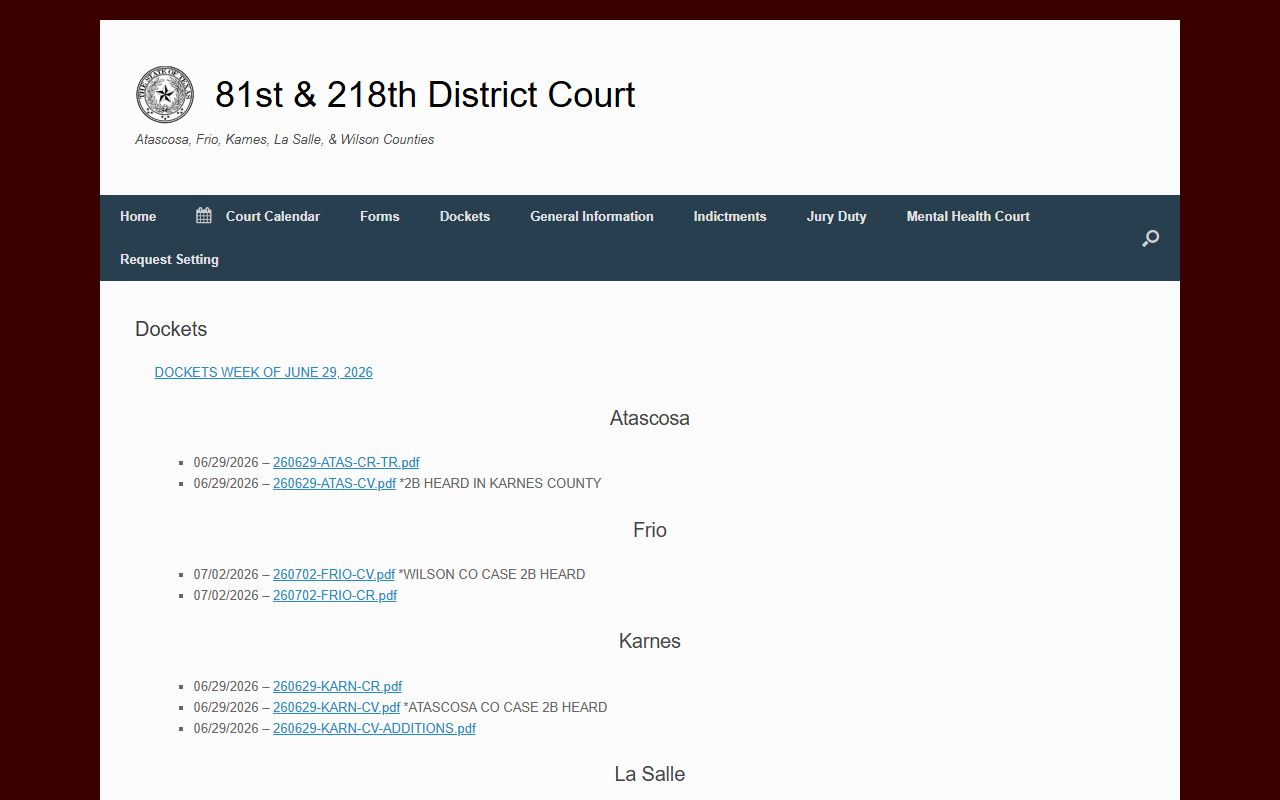
The image shows why a Frio search may require choosing the county and criminal docket PDF instead of expecting a single Frio-only search box.
| Search or Control | Type | Use | Limit |
|---|---|---|---|
| Site Search | Text | Searches the district-court website. | Not a full case-management database. |
| Court Calendar | Page/menu | Checks hearing dates and court events. | May not show every filing in the case. |
| Dockets | Page/menu | Opens weekly PDF docket lists. | Shows settings, not complete case history. |
| County Heading | Page grouping | Separates Frio from other counties in the district. | Must pick the correct county and case type. |
| PDF Docket Link | File link | Displays the criminal or civil docket. | Current week and additions may be separate. |
Frio Court Records Offices
The Frio District Clerk is the key local office for district-court records. The county page lists District Clerk Ofilia M. Trevino at 500 East San Antonio Street, Box 8, Pearsall, Texas 78061, phone 830-505-2996, fax 830-505-7313, and districtclerk@friocounty.org. For open-records requests or searches that pertain only to the Frio County District Clerk's Office, the page directs requests to openrecords@friocounty.org. The posted hours are Monday through Friday, 8:00 am to 5:00 pm.
The prosecutor contact depends on charge level and court path. The District Attorney page lists Audrey Gossett Louis at 1105 A St., Floresville, Texas 78114, phone 830-393-2200, and fax 830-393-2205. The County Attorney page lists Joseph Sindon at 500 East San Antonio Street, Box 1, Pearsall, Texas 78061, phone 830-505-2986, and fax 830-505-7128. Prosecutor pages are not substitutes for clerk records, but they help identify which office may be handling filed charges.
Frio District Clerk
500 East San Antonio Street, Box 8
Pearsall, TX 78061
830-505-2996
Open records/search email: openrecords@friocounty.org
Frio County Attorney
500 East San Antonio Street, Box 1
Pearsall, TX 78061
830-505-2986
County-level and misdemeanor matters may route here.
Frio Court Charging Records
Charging documents are the bridge between a jail arrest and the court record. A complaint is a sworn allegation. An information is a prosecutor-filed charge. An indictment is a grand jury charge, most often discussed in felony prosecution. These documents may not repeat the booking wording exactly. The jail may list an arrest charge from the arresting agency, while the court file tracks the charge selected by the prosecutor or grand jury.
| Document | Who Uses It | What It Does | Frio Search Note |
|---|---|---|---|
| Complaint | Officer or prosecutor | States a sworn allegation that may support arrest or charge filing. | May appear early, before the final charge path is clear. |
| Information | Prosecutor | Files a charge without grand-jury indictment where allowed. | Check court and clerk records for the filed charge text. |
| Indictment | Grand jury | Accuses a defendant of a felony offense after grand-jury action. | District-court docket entries may show the case after filing. |
Frio Court Charge Status
Charge status is the part of court records after a jail arrest that often changes the most. A charge can be pending at filing, amended by later action, reduced during plea talks, dismissed by the state or court, or resolved by conviction. A docket PDF may show the case type or reason for setting, but it should not be read as the whole file. When a status has real legal effect, verify it with the clerk or the court of record.
| Status | Plain Meaning | Why It Matters |
|---|---|---|
| Pending | The filed charge is open and unresolved. | Hearings, bond terms, and attorney activity may still change. |
| Amended | The charge or wording changed after filing. | The court record may no longer match the booking allegation. |
| Reduced | The charge changed to a lesser offense. | Case level, penalties, and court handling may change. |
| Dismissed | The charge is no longer proceeding on that count. | A dismissal is not the same as automatic expunction. |
| Conviction | A judgment of guilt or plea/conviction has been entered. | This is different from an arrest or accusation. |
Note: A public docket setting may lag behind a new order, so use the clerk for case-file confirmation.
Frio Arrest Bond Records
Bond is governed mainly by Texas Code of Criminal Procedure Chapter 17. Article 17.15 lists rules for fixing bail, including appearance assurance, the nature and circumstances of the offense, ability to make bail, and public or victim safety. Frio County research did not locate a local bond schedule, accepted-payment list, or bond-counter hours, so immediate release questions should be verified through the Frio County Sheriff's Office or the court that set the bond.
A bond entry is not just a dollar figure. A person can have a cash bond on one Frio charge and still be held on a parole violation, bench warrant, ICE detainer, another county warrant, or no-bond order. Court records may show bond conditions and future settings after filing, while the jail is still the best source for whether payment will actually produce release that day.
| Bond Type | How It Works | Frio-Specific Caution |
|---|---|---|
| Cash bond | The full bond amount is paid directly. | Confirm where and how payment is accepted before travel. |
| Surety bond | A licensed bail bond company posts bond for a fee. | Texas permits commercial bail bonding. |
| Personal or PR bond | Release is based on a promise to appear and conditions. | Must be allowed by the magistrate or judge. |
| Property bond | Property is pledged to secure court appearance. | Not a quick jail-counter assumption. |
| No-bond hold | Release is blocked by an order or another hold. | Paying one local bond may not clear all holds. |
Frio Warrants and Court Records
No official Frio sheriff active-warrant search page was located in the reviewed county sources. A warrant can still lead to a Frio jail booking, and a bench warrant or capias can appear after a missed setting or court noncompliance. The district-court docket may show settings and comments, but it is not a live warrant database. Texas also does not provide one simple public statewide search for all local warrants.
For warrant-related court records after an arrest, start with the issuing court or the Frio County Sheriff's Office. District Clerk searches are limited to records held by that office. Justice of the peace and municipal cases may have bench warrants that do not appear on the district-court docket page. If a warrant is active, relying on unofficial databases is a poor substitute for the court or sheriff.
Frio Charge vs Conviction Records
A charge is an accusation. A conviction is a final guilt finding, guilty plea, or other judgment of guilt. This distinction matters because Frio County court records after arrest may show a filed charge for weeks or months before the case is resolved. Dismissed, reduced, and amended counts can also remain visible in court records unless a later expunction or other order changes access.
| Point | Charge | Conviction |
|---|---|---|
| Stage | After accusation or filing. | After plea, verdict, or judgment. |
| Meaning | The state alleges an offense. | The court has entered guilt or conviction. |
| Can Change | Yes, it may be amended, reduced, or dismissed. | Can change through appeal or later court action, but not by routine docket reset. |
| Record Use | Shows pending or historical accusation. | Shows case outcome and sentencing effect. |
Frio Sealed Expunged Records
Texas Code of Criminal Procedure Chapter 55 governs expunction, which can affect future access to arrest and booking records after qualifying outcomes. The research file did not identify a Frio-only expunction rule. Sealing, nondisclosure, and expunction are not the same thing. A dismissal does not automatically make every jail, court, and third-party copy vanish.
| Point | Sealed or Nondisclosed | Expunged |
|---|---|---|
| Public visibility | Hidden from many public searches by court order. | Removed or treated under the expunction order as if it did not exist. |
| Government access | Some agencies may retain limited access. | Access is much more restricted and order-driven. |
| Common trigger | Eligibility depends on case type and Texas law. | Often tied to qualifying dismissals, acquittals, or other Chapter 55 grounds. |
| Practical step | Get the signed order and send it where required. | Follow the expunction order for each record holder. |
Restricted Frio Court Records
Texas public-records access is broad, but not unlimited. Texas Government Code Chapter 552 is the Public Information Act framework, and the Texas Attorney General provides a public overview explaining that government records may be inspected or copied unless an exception applies. Sensitive records can be withheld or redacted. Juvenile records, sealed or expunged records, medical details, protected victim information, active investigation material, and court-ordered restrictions can limit what is released.
Criminal-history reporting is also separate from a court docket. Texas Code of Criminal Procedure Chapter 66 covers criminal-history reporting, including arrest reporting to DPS, but a DPS criminal-history channel is not the same as Frio County district docket review. A docket answers court-scheduling and filing questions. A jail record answers custody and booking questions. A criminal-history response follows a different state process.
Important: Court records, jail records, and background reports serve different purposes; verify official status with the record-holding office.